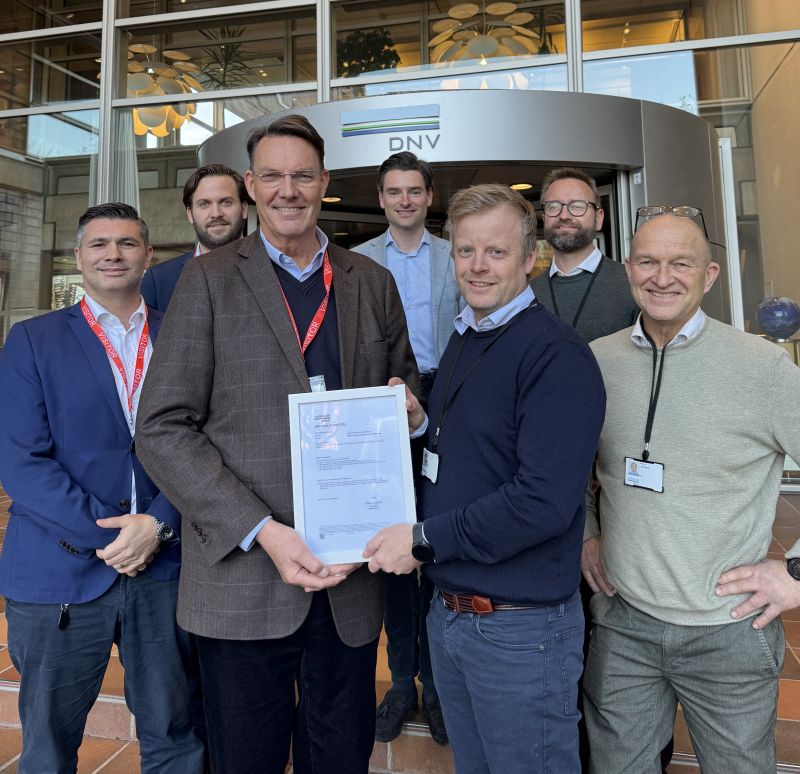

On December 17th, 2025, LATTICE International AS was awarded an Approval in Principle (AiP) by DNV for a 20,000 m3 tank design for storing liquid CO2 (LCO2). The AiP was handed over by Mathias Sørhaug (Director CCS) to Paal Braathen, CEO of LATTICE at DNV headquarters at Høvik, with ceremony attendees including Magnus Lindgren (Senior Principal Surveyor), Endre Lajord (Head of Section, Gas Carrier Excellence Center) of DNV, Kristian Holm (Sr. Project Engineer) of Yinson Production, and Jørgen Fredrik Agerup (COO) and Jon E. Bergan (CCO) of LATTICE International.
The awarded LATTICE Pressure Vessel (LPV) tank design has undergone an extensive engineering and finite element analysis (FEA) in accordance with the IGC Code and relevant Class rules, including full structural, fatigue- and crack propagation-, sloshing-, and buckling analyses. Multiple LPV tanks are foreseen integrated for operation into a Floating Storage and Injection Unit (FSIU), should the solution be selected by end client.
LPV represents the first-of-its-kind prismatic (box-shaped) containment solution to ever be certified for storing LCO2 for this type of application, or at this scale, while meeting the pressure-rating required for secure and effective storage. Achieving 20,000 m3 for a single tank constitutes a 2–3-time capacity leap over what is feasible with conventional state-of-the-art type-C pressure vessels. In addition, the LPV technology enables a highly optimized tank design that can be integrated more efficiently within a hull structure with substantial cost reductions and verified benefits comparatively.
Carbon Capture and Storage (CCS) provides a critical pathway for decarbonizing energy-intensive industries. Implementing large-scale LCO2 containment solutions that can effectively accommodate the tremendous volumes required for capturing, handling, and transporting CO2 throughout the entire value chain will ultimately impact and define our trajectory towards achieving net zero emissions.